 PartnerRound
Bain Online Test · Guide and free practice
Bain SOVA Test
The SOVA test is the online assessment some Bain offices send after you apply: short reasoning questions on numbers, patterns and passages, then situational judgement and a work-style questionnaire, with speed counting alongside accuracy. This guide covers how it runs, what candidates report it scores, the mistakes that cost the most, and a full practice test to sit first.
- Time
- About 30 to 40 min
- Structure
- Reasoning and judgement
- Tools
- Pen, paper and calculator
- Scored on
- Accuracy and speed
35 min · runs in your browser · no download · free for now
On this page
What is the Bain SOVA Test?
The Bain SOVA test is an online aptitude assessment, run on the Sova platform, that some Bain offices use to screen applicants before interviews. Candidates report multiple-choice sections in numerical, logical and, in some sittings, verbal reasoning, followed by a situational judgement test and a work-style questionnaire. Bain says the whole assessment takes about 30 to 40 minutes.
The format at a glance
| Where it appears | After you apply to some Bain offices, reported mainly in Europe and the Middle East. Your invitation says whether you sit SOVA or TestGorilla. |
|---|---|
| Time | Bain puts the digital assessment at about 30 to 40 minutes. Some candidates report it running longer once the questionnaire is included. |
| Reasoning parts | Numerical reasoning from tables and charts, logical reasoning with sequences and rules, and often verbal reasoning judged True, False or Cannot say. |
| Behavioural parts | A situational judgement test set at work, and a questionnaire on how you prefer to work, which has no right answers. |
| Timing | Reportedly no hard limit per section, but the time you take is recorded and reported to count, so pace matters. |
| Tools | Bain allows pen, paper and a calculator for the assessment, though calculators are not allowed in the interviews that follow. |
| One sitting? | Not required. Bain says you can split it, as long as every section is finished by the deadline in your invitation. |
How the Bain SOVA runs
- 1
Invitation
After you apply, an email tells you whether to sit SOVA or TestGorilla and gives a deadline. Bain says the result is one part of the review alongside your application, and that an unfinished assessment means the application is not considered.
- 2
Numerical reasoning
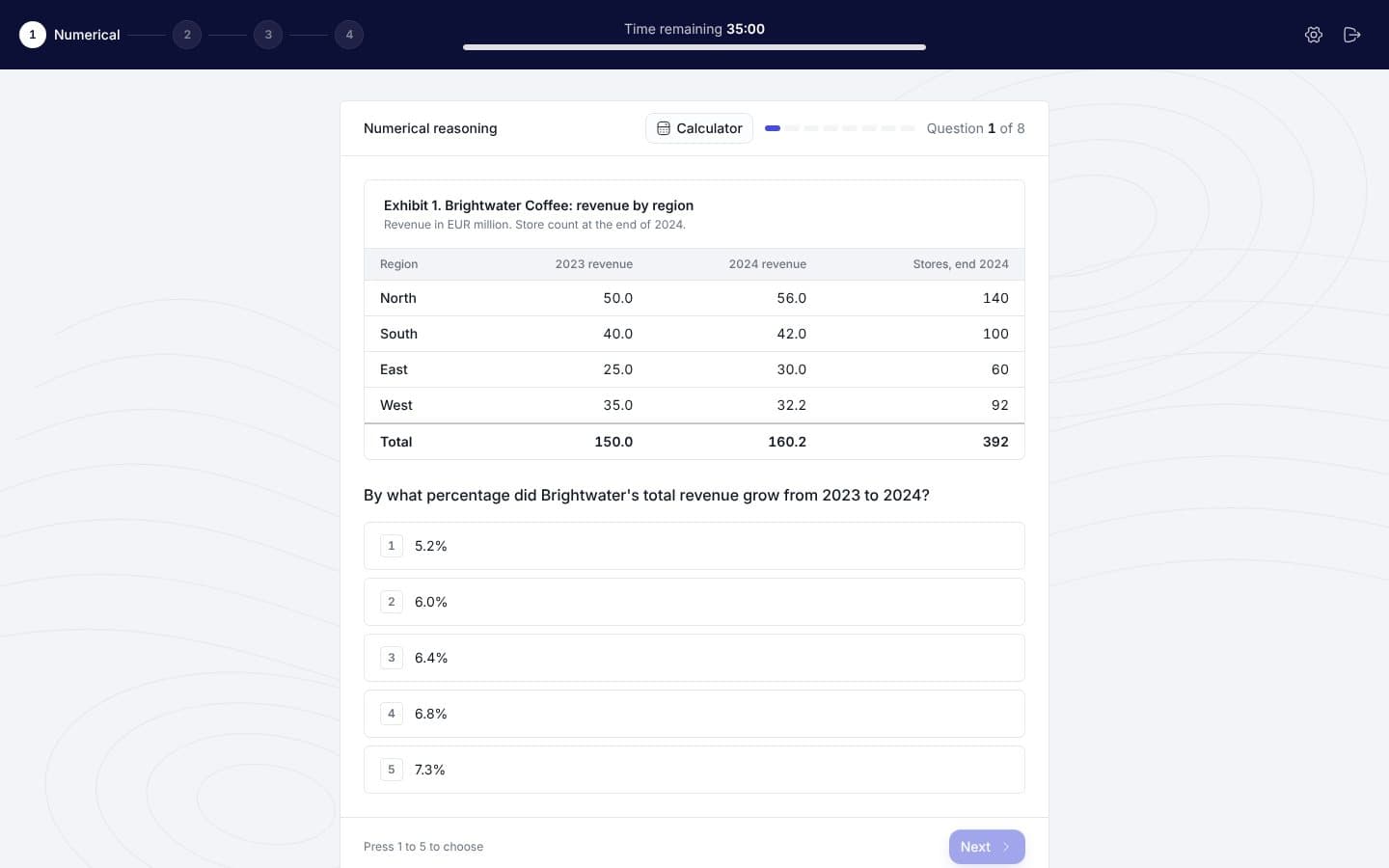
Candidates describe a table or chart followed by several questions on it, asking for a percentage change, a share, a ratio or a comparison. Answers are multiple choice, and the arithmetic is simple once the right figures are found.
- 3
Logical reasoning
Mostly sequences of shapes or figures where you find the rule and choose what comes next. Some candidates also report number series and questions where you apply a stated rule or draw a conclusion from given facts.
- 4
Verbal reasoning
A short passage with statements to mark True, False or Cannot say, judged on the passage alone. Several recent accounts say this part was missing, and it appears to vary by office and intake.
- 5
Judgement and work style
Workplace scenarios where you are reported to pick the most and the least effective response, and a questionnaire rating statements by how well they describe you. Some candidates meet these before the reasoning parts rather than after.
How the Bain SOVA is scored
Bain does not publish how SOVA is scored or what counts as a pass. Candidates and coaches widely report that two things count, which is why the simulation scores both.
How many you get right
Accuracy across the reasoning parts, reportedly compared with other candidates rather than against a fixed mark. The judgement scenarios and the questionnaire are said to be read against the behaviours Bain looks for, not marked like the reasoning.
How quickly you get there
The sections are reportedly not hard-timed, but the time you take is recorded and counts. Taking twice as long over the same answers is likely to cost you, while a fast wrong answer earns nothing.
How to do well in the Bain SOVA
01
Read the exhibit before the question
Spend a few seconds on the title, the units and the period of each table or chart first. Most numerical errors come from reading millions as thousands or a part as the total, not from the arithmetic.
02
Estimate before you calculate
Round the figures and work out roughly where the answer should land. Two or three options can often be ruled out by size alone, and the calculator then confirms rather than leads.
03
Track one change at a time in sequences
Look at each element on its own: position, rotation, shading, count. Test the simplest rule first, such as a fixed step or an alternation, and combine rules only when one alone does not fit every frame.
04
Treat Cannot say as a real answer
Mark True only when the passage states it or it follows directly, and False only when the passage contradicts it. If deciding needs outside knowledge or an assumption, the answer is Cannot say.
05
Answer the scenarios as a good new consultant would
Favour responses that deal with the problem early, keep the right people informed and protect the client and the team. For least effective, look for the option that ignores the problem or acts well beyond your role.
06
Set a pace and hold it
A widely shared rule of thumb is under about 45 seconds per numerical or logical question and about 30 per verbal one. When a question runs well past that, make your best choice and move on.
The mistakes that cost the most
Choosing False when the passage is silent
A passage that does not mention something has not contradicted it. Statements are written to test exactly this, so the confusion costs a mark every time it appears.
Calculating from the wrong base
Percentage change divides by the earlier figure and a share divides by the total. The answer from the wrong base is usually among the options, because it was put there to catch you.
Treating untimed as unhurried
No countdown does not make time free. Reports say speed is scored, so checking every answer twice spends the very thing being measured.
Gaming the questionnaire
Answering as the candidate you imagine Bain wants tends to give an inconsistent profile, because questionnaires like this ask about the same trait in several ways. Answer honestly and steadily.
Leaving it close to the deadline
Bain says applications are not considered if the assessment is not finished in time. A technical problem or a slow section late on can cost the whole application.
How to practise for the Bain SOVA
- 1Play Bain SOVA
Run the full simulation once, under time
Treat the first run like the real thing: the 35 min clock, no pausing, no notes beyond what the test allows.
- 2
Read the review line by line
Every answer is scored and explained. The points lost early usually explain the later ones, so start at the top.
- 3Case maths drills
Drill the arithmetic until it is automatic
Percentages, ratios and growth come up constantly. Ten timed questions a day frees the clock for the thinking.
- 4Open the case library
Practise the interviews that come next
Passing the online test leads to case interviews. Work the Bain cases in the library with the AI interviewer.
- 5See your progress
Rerun and watch the trend
Your runs are saved to your progress, so you can see whether each change in approach moved the score.
What the simulation reproduces
- The four parts most candidates report, numerical, logical, verbal and situational, in 30 original questions
- Numerical questions built on a table, a line chart and a pie chart, with a calculator to hand
- Shape and number sequences, deductions from given statements, and passages judged True, False or Cannot say
- One 35-minute clock, paused on the instruction screen before each part, and no going back once you move on
- Scoring on accuracy and on pace against a target time per question, with a review that explains every answer
Where it differs from the real test
- The questions, exhibits and passages are our own, and the personality questionnaire is left out because it has no right answers
- Situational judgement asks for the most effective response, with half credit for a reasonable second choice, where the real test is reported to ask for the most and the least effective
- Pace targets follow coaches' suggestions, not SOVA's unpublished model, and you can replay as often as you like
Try the Bain SOVA now
Numerical, logical and verbal reasoning, then situational judgement. Full length, timed, with a scored review.
Bain SOVA questions, answered
How long is the Bain SOVA test?
Bain's own guidance puts the digital assessment at about 30 to 40 minutes. Some candidates report it taking longer, mostly because of the work-style questionnaire, and Bain says you need not finish it in one sitting as long as every section is done by the deadline in your invitation.
Will I get SOVA or TestGorilla for Bain?
It depends on the office. After you apply, Bain emails to say which platform you need to complete, so check the invitation before you start preparing. The reasoning skills overlap, but the formats differ, so practise the one you were sent.
Is the Bain SOVA test hard?
Each question is short and the maths stays at percentages, ratios and averages, so most of the difficulty comes from pace and from traps such as False versus Cannot say. Candidates report that speed is scored as well as accuracy, so the challenge is staying accurate without slowing down.
Can you use a calculator in the Bain SOVA test?
Yes. Bain says pen, paper and a calculator are allowed for the digital assessment, though not in the interviews that follow. Keep one beside you, but estimate first: it is quicker and catches answers that are out by a factor of ten.
Is the Bain SOVA test timed?
Candidates report no hard time limit per section and no countdown per question, but the time you take is recorded and counts towards your result. A common rule of thumb is under about 45 seconds per numerical or logical question and about 30 per verbal one.
How should I prepare for the Bain SOVA test?
Try the sample questions in Sova's candidate preparation area, which Bain recommends, then sit a full timed practice test and review every miss. Drill percentage change, shares and quick chart reading, practise True, False or Cannot say on short passages, and answer the questionnaire honestly on the day.
Related practice
 The Bain hubEvery Bain simulation, the process and how its interviews runCase maths drillsTimed percentages, ratios, growth and breakeven
Cases modelled on Bain interviews
Other firms' assessments
A research study and three short cases where half the data is a distraction.
McKinsey Solve · 35 min
Screen microbes across three sites, then average three into a treatment.
McKinsey Solve · 30 min